Seva Mandiras: Service as Divine Worship
Abhhi Trust has embarked on a pioneering project to promote "Seva Mandiras" in rural areas. This initiative aligns with Swami Vivekananda's call to serve the neglected masses in remote villages and is aptly named "Seva Mandira," where service itself is regarded as worship to the divine.
Swami Vivekananda's Vision
Swami Vivekananda envisioned hut temples evolving into great institutions, with relief work proceeding from these central spots in each district
What is a Seva Mandira?
The primary objective of Seva Mandiras is to provide holistic support to the rural poor, encompassing cultural, spiritual, and academic aspects, all under one roof. Each Seva Mandira serves multiple vital functions for the community.
Knowledge Hub
A center for learning and information dissemination
Skill Training Centre
Practical skills development for employment
Community Welfare
Supporting the wellbeing of all villagers
Cultural Hall
Celebrating traditions and arts
Place of Worship
Spiritual guidance and devotion
Community-Driven Management
Seva Mandiras are managed by dedicated volunteers, including local youth and social workers. The fundamental principle is "by the people and for the people."
Identify
Local school teachers, leaders, and service-minded volunteers
Train
Comprehensive training at Abbhi Nivas
Lead
Guide Seva Mandira Operation Committee in their respective areas
Seva Mandiras at a Glance
Bettahalli Sevamandira
3,500 people served
3 villages
Chatranahalli Sevamandira
4,000 people served
6 villages
Chittanahalli Sevamandira
3,500 people served
6 villages
Dabbahalli Sevamandira
6,200 people served
4 villages
Hosakote Sevamandira
3,000 people served
5 villages
Kalihundi Sevamandira
7,100 people served
5 villages
Maddenahatti Sevamandira
2,500 people served
5 villages
Marasingnahalli Sevamandira
4,300 people served
6 villages
Neralekere Sevamandira
3,800 people served
3 villages
Vaddarakoppalu Sevamandira
1,700 people served
1 village
Two Pillars of Service
Seva Mandira demonstrates two important aspects of service that work together to uplift rural communities and provide comprehensive support to underserved populations.
Jnana Prasara Mandira
The knowledge dissemination centre dedicated to education and enlightenment in rural communities.
Nara Narayana Seva
The service side of Seva Mandira, providing direct assistance and support to those in need.
Knowledge Centre
Jnana Prasara Mandira: Knowledge Dissemination Centre
The Jnana Prasara Mandira serves as a knowledge dissemination centre, catering to the educational, cultural, and spiritual needs of villagers. Positioned on the right side of Seva Mandira, it offers direct support to underprivileged Kannada medium students from nearby government schools.
Essential knowledge required for livelihood, including subjects like English, Science, and Mathematics, is imparted through supportive educational training. This centre operates as a modern "Patashala," teaching important shlokas from the Bhagavad Gita, Upanishads, Ramayana, and the Mahabharata.
Educational Focus
- English language skills
- Science fundamentals
- Mathematics training
- Cultural heritage
- Spiritual teachings
Service Hub
Nara Narayana Seva Mandira: Service Hub
Service as Worship
The Nara Narayana Seva Mandira represents the service side of Seva Mandira, embodying the message of Sri Ramakrishna Paramahamsa.
Here, regular health camps are conducted for the benefit of all, emphasizing service to the poor as an act of worship. This service hub is located adjacent to the main shrine, symbolising the integral connection between spirituality and humanitarianism.
Shiva Jnane Jiva Seva
"Shiva Jnane Jiva Seva."
Service to humanity is worship of the divine.
This profound message from Sri Ramakrishna Paramahamsa encapsulates the spiritual principle that serving living beings is equivalent to serving God.
Spiritual Heart
The Central Shrine: Heart of Spiritual Practice
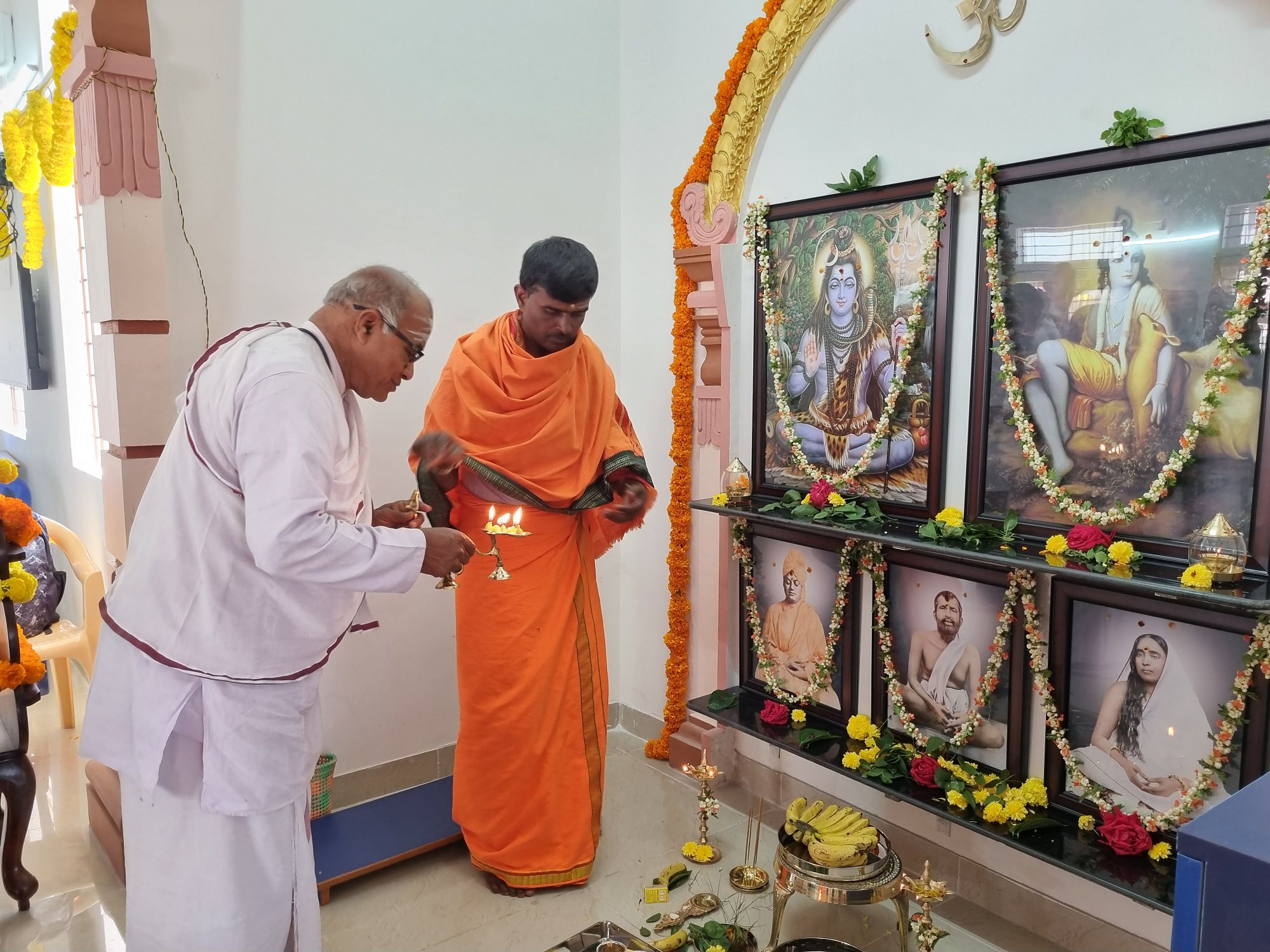
At the heart of every Seva Mandira is the shrine with God's photos, a central structure that reveres Lord Shiva, Vishnu/Krishna, and the Holy Trio. It also pays homage to local deities.
The worship here is simple, devoid of complex rituals. Villagers receive training from the Ashrama to perform meaningful worship, fostering a sense of spirituality within the community.
Lord Shiva
Vishnu/Krishna
Holy Trio
Local Deities
Integrated Approach to Community Upliftment
Each of these aspects—knowledge, service, and worship—is integrated under one roof, fostering a comprehensive approach to community development and upliftment. This unique model creates synergy between spiritual growth, educational advancement, and humanitarian service.
Educational Empowerment
Building knowledge and skills for livelihood while preserving cultural heritage
Health & Service
Providing essential healthcare and humanitarian support to those in need
Spiritual Connection
Fostering meaningful worship practices accessible to entire community
Holistic Development
Creating lasting transformation through integrated approach to human flourishing
Seva Mandiras stand as beacons of holistic community development, where ancient wisdom meets modern needs. By bringing together education, healthcare, and worship under one roof, Seva Mandiras embody a comprehensive vision of human upliftment that honors tradition while addressing contemporary challenges.
The Seva Mandira model demonstrates that true community transformation requires attention to the whole person—mind, body, and spirit—creating sustainable development that enriches lives across generations.
Our Impact Across Rural Karnataka
The Seva Mandira network represents a transformative approach to rural development, combining spiritual values with practical service. Through our centers, we reach tens of thousands of people across Karnataka's rural heartland.
39K+
Population Served
Target population across all Seva Mandiras
10+
Active Centers
Seva Mandiras operating across two districts
40+
Villages Connected
Rural communities benefiting from our services